
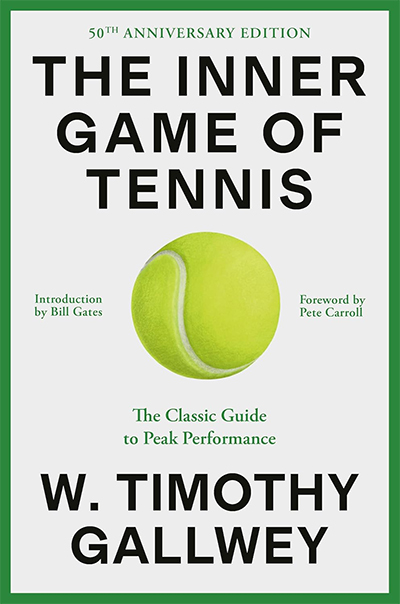
 How did I miss this book for so many years? It’s not just about tennis!
Gallwey has done something remarkable. He divides a person into Self 1 and Self 2.
Self 1 is all about rules, thinking, analyzing, and self-talk. Self 2 is the automatic subconscious brain function. In the tennis example, Self 1 has a running dialogue of “I have to grip this racket, I need to follow through, etc.”
Self 2 knows what you want to do and learns how to do it by watching results.
As a player focuses on Self 1, it distracts Self 2. It slows down Self 2. The more you think about what you’re supposed to be doing and how to do it, the less capable you become. The less well you perform.
All nice in theory. So, I put it to the test on my in-home dart board because I’m reading in the winter and don’t know if my tennis is up-to-snuff enough to even try what he recommends.
Both my Selfs are responsible for tennis balls all over neighborhoods surrounding tennis courts. But trying it on the dartboard — it works! The less I coached myself and thought about corrections to my throw, the better my darts landed.
But, as I said, the book is about more than tennis and darts. He talks about the applicability in relationships, in business, in viewpoint. This is about being alive and present. Being mindful.
There is a beautiful chapter that nominally addresses what to do with competition. But the deeper message is what to do with performance-based personal value. How to overcome it. How to work together to make one another better.
I spoke about the concepts in Gallwey’s book at the February White County Creative Writer’s meeting. I believe the premises in the book are just as valid in writing.
As writers, we often say there are plotters and “pantsers.” Those who make charts and outlines and character sketches galore. And those who pull out the typewriter or word processor and go like mad from the seat of our pants. The whole time I’ve been reading I’ve been applying the lessons to writing. Taking what we need from the plotters, but letting our own inner “pantser” write like the wind because it knows how to better. It knows how to do it more naturally.
We often read books that give advice on some aspect of life to improve. Then the new rage comes out and shifts all that around. I can’t see how that can happen with The Inner Game of Tennis. It could be added to or restated in a different way, but the basic concept in this book stands. It tells us how our brains were designed to work and how they operate most effectively. And knowing that is critical to getting our best writing done.
This book is a must-read.

- The Inner Game of Tennis - February 24, 2026
- Preemptive Creativity - November 28, 2025
- Defeating Writer’s Block - January 6, 2025
The title of this book instantly caught my eye. In my former life I played competitive tennis. After 5 joint replacements, that part of my life is only memory. But when you said the book was about more than tennis, I was intrigued. Sounds like it applies to any type of competition. Mine now is with pen and paper instead of ball and racquet . Thanks for the review.