
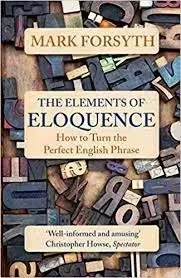
 Okay, here’s one I recommend. For realsies. It’s called The Elements of Eloquence.
Mark Forsyth is a Brit, apparently, but he’s understandable and amusing, nonetheless. This is not a “how-to” guide for authors. It is, however, informative and entertaining.
Mark is a word guy. In this book, there are tons of things we recognize anyway, we just didn’t know we knew them. He breaks down written rhetoric into bite-size pieces.
Rhetoric, for those of you who are like me and recognize the word but couldn’t define it and don’t use it day-to-day, is the apex of communicating. The Greeks were determined to excel in communicating, orally, theatrically, and in writing. We know what it looks like orally when we hear a comedian who times every punch line perfectly. We see it when someone uses gestures and facial expressions to communicate more than the words alone.
This book shares many of the written aspects of rhetoric. The figures of speech. It tells why a quote is quotable, or why it isn’t. How to add punch to a phrase.
Each chapter begins with the Greek word for the concept Mark intends to deliver. Well, most of them do. Some might be words from other languages. But none of the Greek ones are readable. That’s because they’re Greek. Greek is notorious for using weird vowel combinations, consonants we only invented to bring the alphabet up to 26 letters, and … well, a third thing.
There’s a great example of something from the book. One of my favorites. Unfortunately, I’ve skimmed the entire book twice and can’t find it. It’s the use of three things. With its associated Greek word. Wine, women, and song. Sex, drugs, and rock and roll. These sayings would definitely lose power if only two of the three were used.
But there are dozens more, and they are memorable because the Greeks were describing great figures of speech. They weren’t dictating them. If they had been dictating or proscribing, we’d have had to try to memorize them in school and we’d have been frustrated and angry. As it is, they’re merely naming things our brains are drawn to, things we remember.
That’s why even today you remember “float like a butterfly, sting like a bee,” or “roses are red, violets are blue.” That’s isocolon, for those of you who need to know.
Or diacope. Why do we all know what is touted as the 22nd most memorable line in all of cinematography? The man’s name is boring. Mark calls it tedious. But you remember, “Bond, James Bond,” because of how it is worded.
If you’re a writer, The Elements of Eloquence might help you change a line from informative to memorable. If you’re a reader, it might help you appreciate what Shakespeare was up to. If you like quotes, it will illuminate why Oscar Wilde was a master. And if you just like a good book, you can’t go wrong.

- The Elements of Eloquence - June 1, 2026
- The Inner Game of Tennis - February 24, 2026
- Preemptive Creativity - November 28, 2025